Why Do Designers Use Circles When Presenting Logos To Clients? Genius Geometry Or Designer Drama?
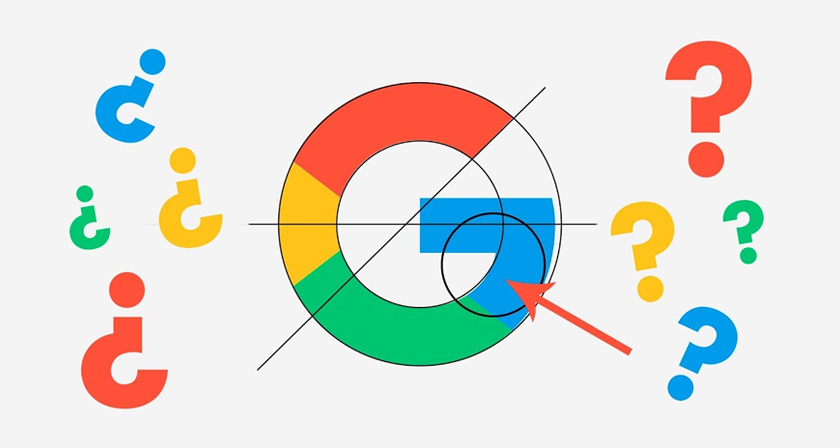
If you’ve browsed logo design breakdowns on Dribbble, Behance, or Reddit, you’ve probably seen those mysterious grids of overlapping circles layered over a logo. They are often presented as if they belong to some sacred geometry that makes the design more precise and universally appealing.
The question is whether these circles genuinely enhance the logo or if they are simply a form of design theater created to impress clients and followers. A lively online debate recently unpacked this question, and the answers are as funny as they are insightful.
Here are the best replies:
1.
Justification for charging 20k for a logo.
– @techmnml
❤️ 1.1K
Yes. It’s just to show clients who don’t know what you do, that you “thought” of everything that you did, makes you look fancy
– @christiv7
❤️ 215
Clients, where I’m from at least, don’t care about those things. They just want sketches then the final product with revisions. Not the fancy stuff they don’t understand.
Design graphic is about going straight to the point in replying to a request, adding superfluous stuff is useless.
Those grid things are a remain of “fake projects” posted on Behance then on Instagram by people that don’t really work in the field IRL to make the whole thing look legit and really thought through.
– @Legitimate-Bit-4431
❤️ 23
2.
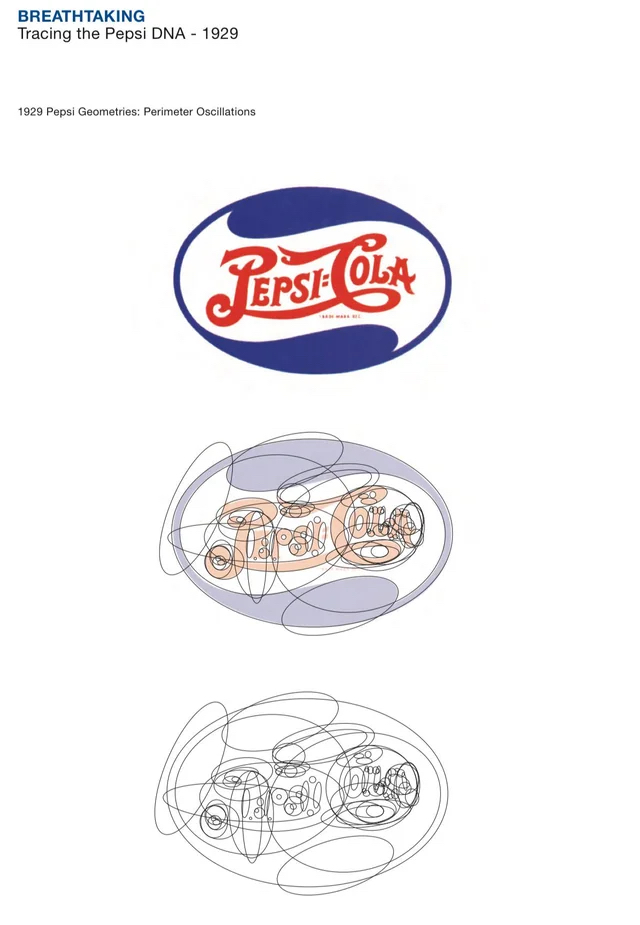
Pepsi universe
– @ watkykjypoes23
❤️ 341
– @ hofmann419
❤️ 171
What a masterclass in bullshitting
– @buynowdielater
❤️ 52
I remember when Pepsi claimed that globe could be constructed using a compass and straightedge.
I followed all the steps in illustrator, until I got to maybe the third-from-the-last step, which didn’t seem to be based on any of the previous geometry at all.
– @2xspectre
❤️ 89
3.
I always think these are done after the fact to “show” a client how you’re making perfect design choices. Notice how the bottom right two small circles are actually not at all in how the finish piece looks?
– @CinephileNC25
❤️ 212
4.
People do that to make their design process look complicated and thought out and justified. It’s portfolio or social media nonsense.
– @foxyfufu
❤️ 614
Sometimes, it’s still a good business move. Some clients love that. And are more happy to pay (more? noooo…) whent they think they pay for something which appears difficult to create.
– @plantaxl
❤️ 67
5.
This allows us to justify the price to customers who understand nothing about our business.
– @Emmuel77
❤️ 89
6.
Most of the time it’s just nonsense.
– @TrickHH
❤️ 169
7.
They are used for more stable replication of the logo across mediums (print, embroidery, uniforms, etc.) and for enforcing brand identity rules.
It’s basically the logo design equivalent of a layout grid. The lesson: a logo has to be practical and reproducible, not just visually impressive.
– @motus200
❤️ 19
8.
A grid is used to help ensure the final logo is balanced, spaced and aligned.
– @Joseph_HTMP
❤️ 70
9.
In pre-digital days, circles were used as guides when enlarging logos by hand.
Designers used compasses to ensure proportions stayed accurate at different sizes, since scaling with machines often blurred details.
Logos had to be designed for reproduction across a range of sizes, so circles helped maintain consistency.
– @Professional_Ad_96
❤️ 15
10.
It’s supposed to show how they built the design, like a reveal of underlying structure.
95% of time it’s totally superfluous, and there is no system they followed. Like the one you show. It’s just tacked on for effect to make it look like they did something complex. It’s a stupid trend.
– @PunchTilItWorks
❤️ 10
11.
In the vast majority of cases, the people who make these grids misuse it. You can tell when a logo designer actually designs this way from the start.
It shows in the simplicity and structure of the final logo. In cases like your example, OP, the grid makes sense maybe for the Star the torch, and the pill shape container, but not really for any other part of that design.
It’s just a weird trend for the last 15 years or so to do this to make logomarks feel more “thought out” than they really were… AFTER the matter.
But if you actually try designing this way from the beginning, it’s a fun process.
– @TheDiegoAguirre
❤️ 7
12.
Construction guidelines exist so a logo can be replicated consistently after the designer is gone. If a mark is highly geometric, grids make sense.
But random circles without reference points are useless. A simple square grid based on visible units is often more practical, making logos easier to reproduce and apply.
– @Paella007
❤️ 11
13.
This is an incredibly effective tactic for getting c-suite people to think you’re a goddamn genius
– @verminqueeen
❤️ 5
14.
Circle grids are often tied to the Fibonacci Sequence (Golden Ratio), a natural proportion that creates visually harmonious compositions. Used well, it helps logos feel balanced and natural; used poorly, it’s just decorative.
– @Warboss-IronShreddah
❤️ 4
15.
For bullshitting. I use them to make it look like I spent 10 hours on something that took me only 1 hour.
– @DeeplyMoisturising
❤️ 3
Making Sense of the Circle Obsession
1. Circles as a Tool for Proportion
Circles can act as construction guides, helping designers create consistent curves, balanced arcs, and shapes that scale reliably across different applications. Historically, before digital tools, circle grids were practical for redrawing logos by hand or preparing them for signage, embroidery, and print. Even today, a circle-based system can bring reproducibility and polish.
2. Geometry and Harmony
There is a long tradition of using geometry, whether circles, squares, or golden ratio spirals, to bring a sense of harmony to design. When applied thoughtfully, these structures can give a mark mathematical neatness that feels subconsciously pleasing. Iconic examples include the Apple logo and the pre-X Twitter bird, both of which were deliberately constructed from overlapping circles.
3. The Illusion of Process
Much of the time, the grids and circles seen in logo presentations are retrofitted after the fact. They function less as design tools and more as stagecraft: a way to signal hidden complexity, impress clients, or elevate a portfolio piece. This practice has been called everything from “design astrology” to a “masterclass in bullshitting.” It gives the impression of rigorous geometry even when the final logo does not actually align with the overlaid circles.
4. Why Circles Alone Do Not Matter
Perfect geometry does not guarantee strong design. A weak idea dressed up with construction lines remains a weak idea. Visual accuracy and optical adjustments often matter more than mathematical precision. The most successful marks strike a balance: concept first, refined geometry second.
Real-world logos show both sides of the circle debate. Apple used geometry to achieve enduring simplicity, while the pre-X Twitter bird became a case study in overlapping circles done right. Pepsi, on the other hand, became infamous for its over-intellectualized brand book. And countless Behance portfolios keep the ‘circle soup’ tradition alive, more for show than process.”
The Takeaway
Circles in logo design are a double-edged tool. Used deliberately, they help refine form, unify proportions, and communicate harmony. Used performatively, they become little more than designer theater, an aesthetic overlay that looks impressive but adds no real value. The distinction lies not in the circles themselves, but in whether they genuinely shaped the design or were tacked on afterward.
So next time you see a logo surrounded by dozens of perfectly aligned circles, remember — it might be genuine geometry, or it might just be designer theater.
What do you think? Do circles really make logos better, or are they just for presentation flair? Share this post with a designer friend and voice your views in the comments below.