7 Reasons Why The 7-Eleven Logo Works Even Though It Breaks Design Rules
Some logos are designed to be admired. Others are designed to disappear into everyday life so completely that they stop feeling like design altogether. The 7-Eleven logo belongs to the second category.
It hangs above storefronts, appears on cups, receipts, delivery bags, roadside signs, and convenience store shelves across the world. Most people have seen it thousands of times without ever really studying it. The brain recognizes it instantly and moves on.
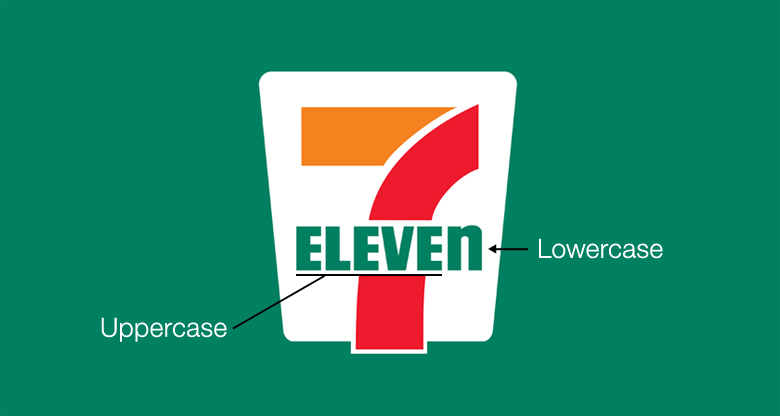
But look closely at the 7-Eleven logo, and it starts to feel strangely unresolved. The word “ELEVEN” is not written entirely in capitals. The final “n” is lowercase. The alignment is slightly off. The spacing feels uneven in places.
By conventional standards, several things about the logo are technically wrong.
And yet it works brilliantly. For more than fifty years, the 7-Eleven logo has remained one of the most recognizable retail identities in the world — despite breaking many of the rules modern branding systems are built around.
That’s not luck. Here’s what’s actually going on.
1. The Lowercase “n” Was Put There on Purpose
The first thing people notice when someone points out the logo’s quirks is that final “n.” It’s lowercase. Everything around it — E, L, E, V, E — is uppercase. And once you see it, you can’t unsee it.
The story behind it is more interesting than a typo. According to company lore, the president’s wife looked at an early version of the all-caps wordmark and said it felt too harsh. Too aggressive for a convenience store. So the “n” got softened.
That instinct turned out to be typographically sound. An uppercase N is a rigid, angular character — two vertical strokes with a hard diagonal between them. A lowercase n has a single soft arch. That arch visually echoes the sweeping curve of the red “7” above it, which means the whole mark holds together better than it would if everything were capped. The eye moves through “ELEVEn” more naturally. The ending doesn’t feel like a wall.
Nobody notices this when they’re just walking past a 7-Eleven. Which is exactly the point.
2. The Logo Isn’t Centered and That’s Fine
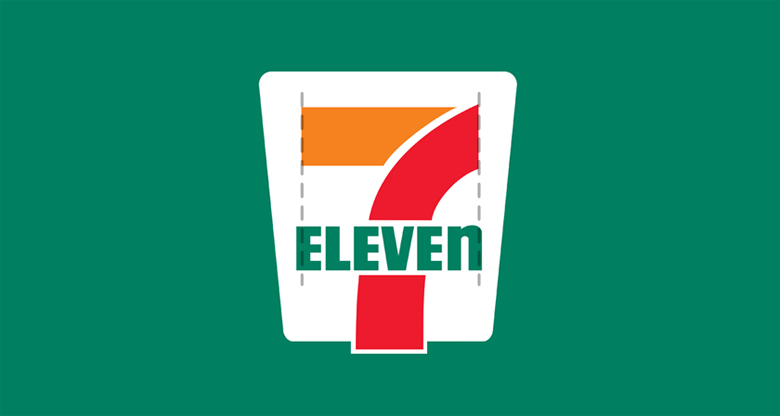
Put a ruler on the 7-Eleven logo and things get uncomfortable. The wordmark doesn’t sit where you’d expect it to. The “7” doesn’t align the way design software would place it. Certain gaps are wider than they should be.
This bothers designers until they remember that logos aren’t experienced with rulers.
The red “7” is enormous relative to the word beside it. It pulls visual weight in a way that throws off any mathematically centered arrangement. So the surrounding elements shift slightly to compensate — not because someone made an error, but because that’s how optical balance actually works.
Type designers deal with this constantly. The letters O and C in almost every typeface are drawn slightly taller than H or T, even though they’re supposed to be the same cap height. If you make them the exact same height by measurement, they look shorter. The eye perceives curved edges differently than flat ones, so you correct for it.
The 7-Eleven logo applies the same logic. What looks off on a grid feels right in the real world. The ruler matters a lot less than people think.
3. Asymmetry and Balance Are Different Things
Perfect symmetry is static. When everything mirrors everything else, the brain settles too quickly and moves on. The 7-Eleven logo doesn’t let that happen — the inner arch spacing is uneven, the type doesn’t sit in mathematically equal proportions against the numeral, the weight distribution leans in ways a design grid would flag immediately. And yet none of it feels unstable.
Symmetry is something you measure. Balance is something you feel. The 7-Eleven logo has plenty of the second and not much of the first, and it’s been working just fine for fifty years.
4. The Quirks Are What Make It Stick
Strong recall in a logo usually comes from two things: distinctive visual anchors and something slightly unexpected.
The 7-Eleven logo has both. The anchors are obvious — the giant red “7,” the green wordmark, the red-orange-green palette that doesn’t really appear anywhere else in retail. Those elements handle recognition at a distance.
The unexpected part is subtler. The lowercase “n,” the asymmetry, the spacing that doesn’t resolve cleanly — none of these are noticeable on their own, but together they give the logo a texture that’s harder to forget than something perfectly resolved. The brain notices things that deviate slightly from expectation, even when it doesn’t consciously register what those things are.
Technically flawless logos can be invisible in the worst way. The 7-Eleven logo has just enough friction to leave a mark.
5. Most Modern Logos Are Too Clean
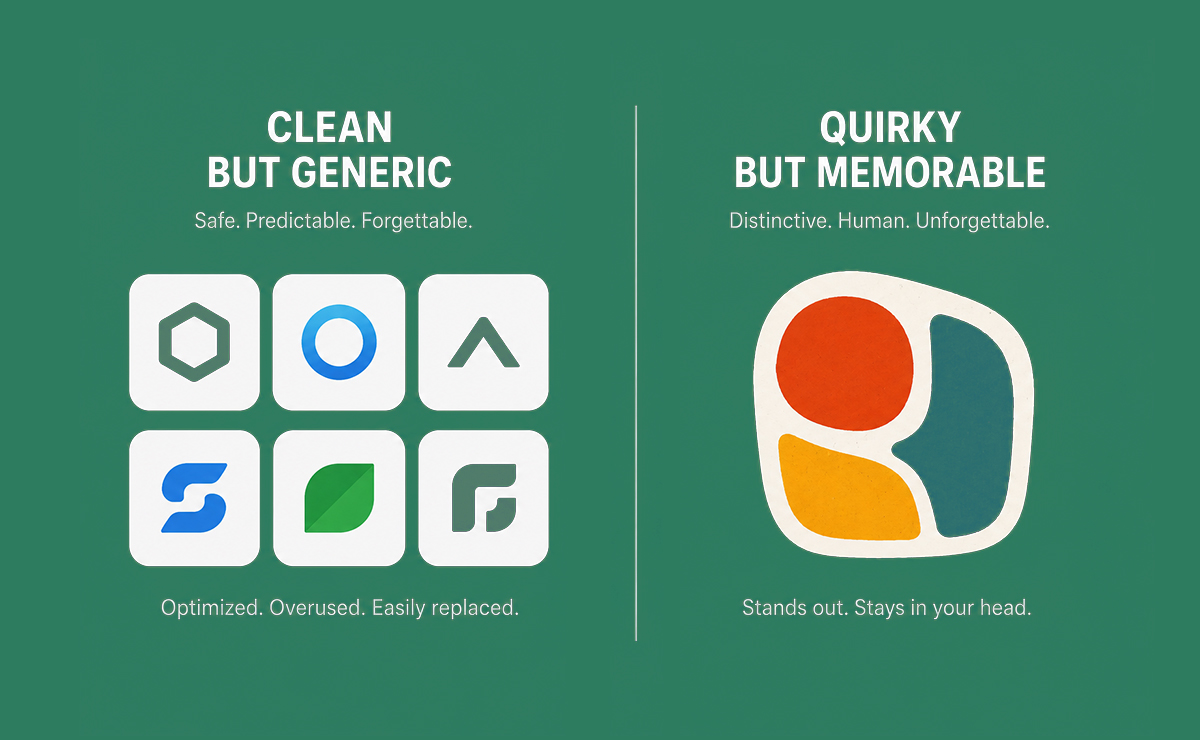
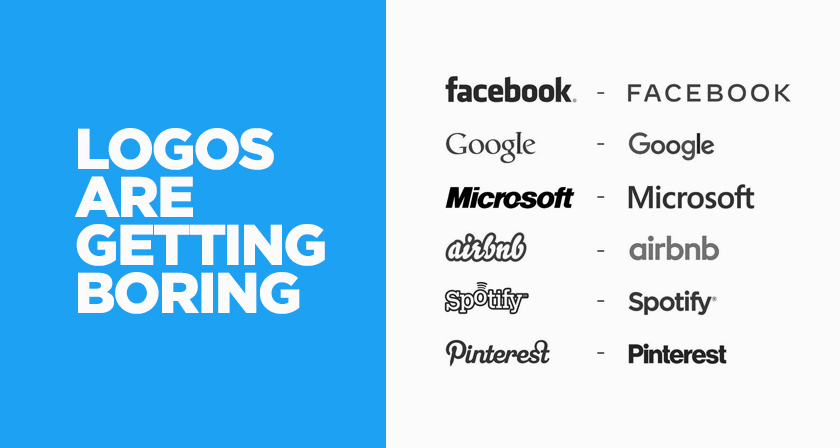
The last decade of brand design has been dominated by a specific aesthetic — flat, geometric, symmetrical, minimal. The thinking made sense at the start. Logos needed to work at 16×16 pixels on a browser tab and also on a billboard, so the solution was to simplify everything down to shapes and weights that could scale without breaking.
The problem is that when everyone solves the same design problem the same way, everything starts looking the same.
Logos that used to have personality — expressive letterforms, unusual proportions, small details that were specific to that brand — got smoothed out into something flexible and forgettable. The 7-Eleven logo never went through that process. The mixed-case lettering stayed. The asymmetry stayed. The bold colors stayed. The slightly awkward geometry stayed.
That’s why it still looks like itself. It was never optimized into blandness.
6. Rules Only Help If You Know When to Ignore Them
Grids, alignment systems, symmetry, spacing ratios — these exist because they work most of the time. They help designers make faster decisions and avoid obvious mistakes. There’s nothing wrong with using them.
The issue is when they stop being tools and start being rules that can’t be broken. Because sometimes the grid produces the wrong result. Sometimes the perfectly centered version looks worse than the slightly adjusted one. Sometimes the optically corrected choice breaks three rules and looks better than anything that follows them.
The 7-Eleven logo is full of those choices. Someone made a judgment call that the lowercase “n” worked better. Someone decided the optical alignment mattered more than the mathematical one. Someone looked at the asymmetry and thought it was fine, because the overall mark felt right.
Those calls were correct. They were also, technically, wrong. That’s the job.
7. The Best Logos Get Out of Their Own Way
Nobody stands in front of a 7-Eleven and thinks about kerning. They see green, they see a red “7,” they know exactly what the building is and what’s inside it. The logo has done its work in under a second and the viewer has already moved on.
That’s what successful logo design actually looks like — not something people admire, but something that communicates so efficiently it disappears. The lowercase “n” never creates confusion. The off-center alignment never reads as a mistake. The asymmetry never feels unstable. All the things that look wrong on a grid feel completely right in use.
The 7-Eleven logo isn’t a great logo despite its flaws. The flaws are part of why it works. It breaks just enough rules to avoid feeling generic, without breaking so many that it stops making sense.
Logos aren’t made for grids. They’re made for people. This one understood that from the start.
Watch Designer Will Patterson’s Breakdown Below
UK-based designer Will Patterson also broke down the logo in a video covering rule-breaking, optical alignment, asymmetry, and why certain “mistakes” in branding can still work in practice.
Jump to: 0:00 – Intro 0:37 – The 7-Eleven logo 1:43 – Going against the norm 3:05 – Capital and lowercase lettering 3:26 – Rounding and flow 4:48 – Alignment 5:29 – Symmetry 6:09 – Good design 7:59 – Outro
Either way, you’re never looking at that logo the same way again. The lowercase “n,” the off-center alignment, the asymmetry that somehow works — none of it was accidental. Someone made those calls, and fifty years later the logo is still standing.
Know a designer who’d find this interesting? Share this article with them.