A Research Study Has Proved That Most People Don’t Know What A Lowercase ‘G’ Looks Like
You’ve seen it a million times, but do you really remember what it looks like?
Most people don’t realize that the lowercase ‘g’ actually comes in two different forms. The one we usually write by hand is simple – a circle with a little tail, also known as the single-storey ‘g’. But the version used in most printed text, in fonts like Times New Roman, Georgia, and Calibri, has an extra loop at the bottom, making it look completely different. This is also known as the double-storey ‘g’.
To test if people actually recognize this double-storey ‘g,’ researchers at Johns Hopkins University ran an experiment. First, they asked 38 people to name letters that have two lowercase forms. Only two of them even thought of ‘g,’ and just one could correctly write both versions.
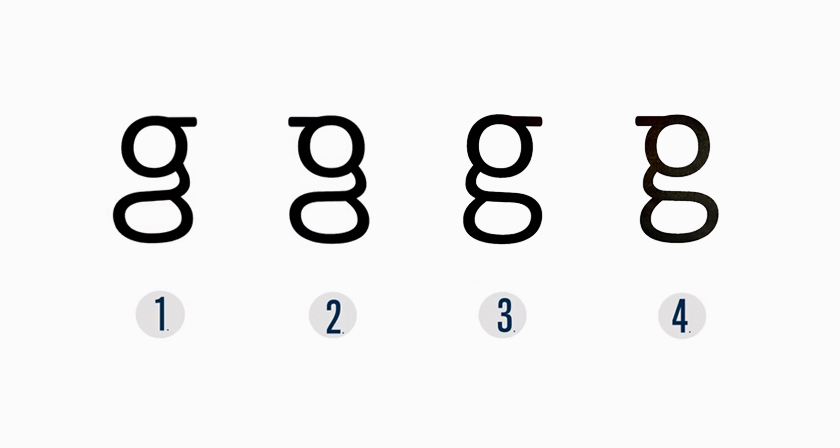
Then came the real challenge. The researchers showed 25 participants four different versions of the double-storey ‘g’ and asked them to pick the right one. Shockingly, 72% of participants chose the wrong one.
Which is the correct one?
This study reveals how little we consciously notice the details of familiar letters. Even though we see the double-storey ‘g’ every day, most of us struggle to recall its exact shape when tested. Think you picked the right one in the image above?
JHU researchers believe that the reason for this confusion is because people are writing less and less nowadays. Learning to write plays a crucial role in learning to read, as writing reinforces letter recognition in ways that reading alone does not. Since we’re never taught to write the double-story ‘g,’ our brains don’t fully register its form, even though we see it constantly in print.
Here’s the research video
As they say, the devil’s in the g-tails! This study is a perfect example of how our brains filter out details we don’t actively engage with. We read every day, yet we rarely stop to analyze the shapes of the letters themselves. As handwriting declines, it’s worth considering what other subtle aspects of language and design might be slipping past our attention.
Share this post with a friend and voice your views in the comments below.