In February 2024, the email ecosystem underwent a seismic shift. Google and Yahoo stopped asking politely for best practices and started demanding them. Now, in 2026, those initial “new requirements” have evolved into the absolute baseline for digital communication.
To survive in the modern inbox, every sender must adhere to the 5 core requirements of the new standard:
- 0.1% – 0.3% Spam Threshold: Spam reports should ideally stay below 0.1%, and no higher than 0.3%.
- Full Authentication (SPF, DKIM & DMARC):
- SPF (Sender Policy Framework): Your strict list of approved IP addresses.
- DKIM (DomainKeys Identified Mail): A digital signature that prevents message tampering.
- DMARC (Domain-based Message Authentication): A policy that instructs servers to reject unverified emails.
- Forward-Confirmed Reverse DNS (FCrDNS): Your sending IP address must have a valid PTR record that resolves back to its hostname.
- One-Click Unsubscribe (RFC 8058): A mandatory header allowing instant opt-out for marketing emails.
- TLS Connection Security: All email traffic must be transmitted over a secure, encrypted Transport Layer Security connection.
Everyone using email should adhere to the strict technical standards of major mailbox providers (MBPs) or face the “digital death penalty”: blacklisting. This can kill a company’s cash flow overnight. For a business sending 5,000 emails a day, a single day of 0.3% spam reports can halt their revenue entirely.
In this high-stakes environment, guessing your DNS syntax is a liability you cannot afford. To guarantee compliance without the headache of manual coding, savvy administrators now leverage an SPF Record Generator. This essential tool visualizes and validates your authentication protocols instantly, ensuring your domain is fortified against rejection before you send a single message.
This is not merely about landing in the spam folder anymore. It is about the complete rejection of your domain’s traffic. Below is the definitive technical audit checklist for 2026, based on the latest enforcement protocols from Google, Yahoo, and major anti-abuse organizations.
1. The 0.3% Threshold: The Hard Ceiling on Spam Rates
The most aggressive metric currently enforced by Google and Yahoo is the spam rate threshold. According to Google’s Email Sender Guidelines, senders must keep their reported spam rate below 0.1% and must never, under any circumstances, exceed 0.3%.
It is crucial to understand that this metric is calculated daily based on user reports (when a user clicks “Report Spam”). Unlike in previous years, where reputation was a nebulous concept, this is now a hard limit.
The Blacklist Implication:
If your domain hits 0.3% repeatedly, you do not just lose inbox placement; you risk triggering internal blocklists at the provider level. Furthermore, high complaint rates are a primary signal for third-party blocklists (RBLs) like Spamhaus.
Once a domain is listed on the Spamhaus Domain Block List (DBL), the deliverability impact is catastrophic and global, affecting not just Gmail and Yahoo, but almost every corporate filter worldwide.
2. Authentication Trinity: SPF, DKIM, and DMARC
The days of relying on a simple SMTP configuration are over. The requirement is now “strong authentication” for all senders, with specific mandates for bulk senders (those sending close to 5,000 emails a day).
SPF (Sender Policy Framework): The First Line of Defense
SPF prevents IP spoofing by specifying which mail servers are authorized to send email on behalf of your domain. However, in 2026, simply having an SPF record is insufficient; it must be syntactically perfect and efficient.
A common failure point for growing businesses is the 10-DNS-lookup limit. As teams add tools, such as CRMs, Helpdesks, Marketing Automation, they bloat their SPF record. If the record requires more than 10 DNS queries to resolve, the protocol breaks (returning a `PermError`), and the email is treated as unauthenticated.
Technical Solution:
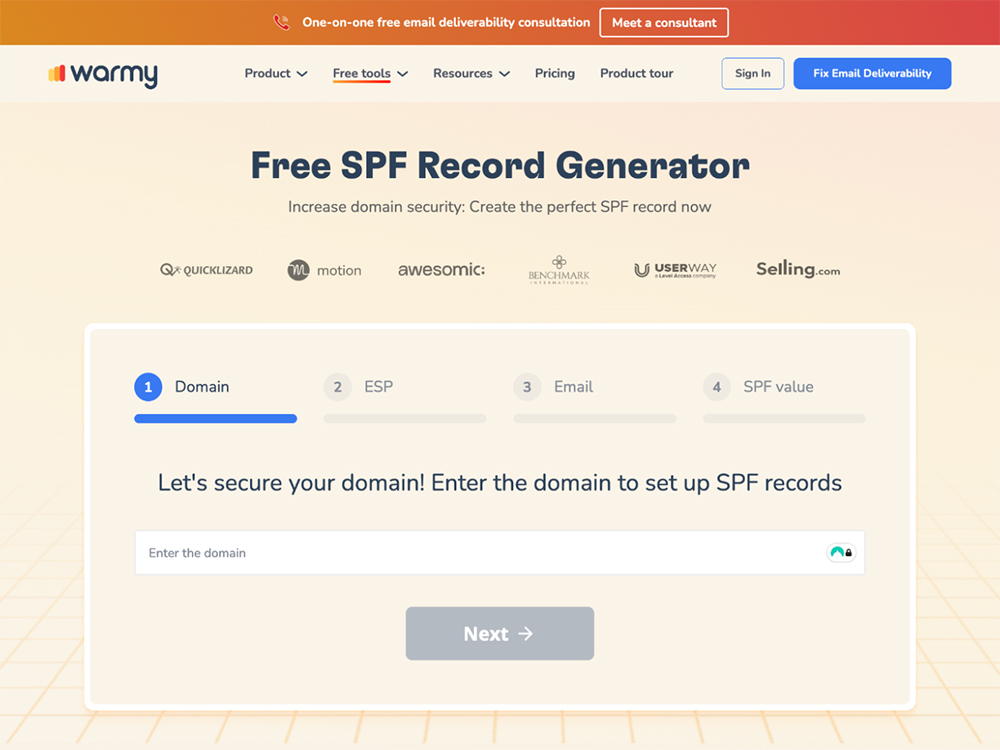
To avoid this silent failure, teams must visualize their infrastructure before deployment. Using a dedicated SPF Record Generator allows administrators to simulate the domain’s state, identify nested lookups from legacy vendors, and generate a flattened, error-free record. This ensures that when Google’s servers query your DNS, they receive a clear, compliant response instantly.
DKIM (DomainKeys Identified Mail)
DKIM provides a cryptographic signature that verifies the email was not altered in transit. Google specifically mandates a key length of at least 1024 bits, though 2048 bits is the recommended standard for 2026 security posture.
DMARC (Domain-based Message Authentication, Reporting, and Conformance)
DMARC bridges SPF and DKIM. For bulk senders, a DMARC policy is mandatory. While a policy of `p=none` (monitoring only) technically meets the minimum requirement for delivery, it offers zero security protection. The industry standard is moving rapidly toward `p=quarantine` or `p=reject` to prevent domain spoofing.
3. Forward-Confirmed Reverse DNS (FCrDNS)
Forward-Confirmed Reverse DNS (FCrDNS) is a two-way network validation process that verifies the legitimacy of a mail server. First, it performs a reverse lookup (PTR) to translate the sender’s IP address to a domain name. Then, it performs a forward lookup (A record) to confirm that the domain points back to the original IP address.
Often overlooked, Forward-Confirmed Reverse DNS (FCrDNS) is a critical requirement for keeping your IP address off blocklists.
FCrDNS implies a “full circle” verification:
- Forward: Your hostname (e.g., `mail.example.com`) resolves to an IP address.
- Reverse: That IP address resolves back to the same hostname.
Anti-spam organizations like SpamCop and URIBL weigh FCrDNS heavily. If an email originates from an IP without a valid reverse DNS (PTR record), it looks indistinguishable from a compromised botnet node. Ensure your hosting provider has configured the PTR records correctly for your dedicated IPs.
4. One-Click Unsubscribe (RFC 8058)
User experience is now a technical requirement. Google and Yahoo require that all marketing and promotional emails support “one-click unsubscribe.”
This does not mean just having a link in the footer. It requires the implementation of the List-Unsubscribe-Post and List-Unsubscribe headers in the email metadata, conforming to RFC 8058. This allows the email client (the Gmail interface itself) to show a native “Unsubscribe” button next to the sender’s name.
Failing to implement this header is a direct violation of the 2026 guidelines. It forces users who want to opt-out to mark the email as spam instead, driving your spam rate up and pushing you closer to that 0.3% blocklisting cliff.
5. TLS Connection Security
Data privacy remains paramount. Google requires that connections for transmitting mail be secured with TLS (Transport Layer Security). If your mail server attempts to hand off data over an unencrypted connection, the delivery may be rejected outright.
This is standard on most modern ESPs, but those managing self-hosted Postfix or Exim servers must verify their SSL/TLS certificates are valid and up to date.
The Cost of Non-Compliance
The path to the inbox begins with a clean infrastructure, auditing your headers, securing your PTR records, and ensuring your SPF record is valid. Automating these checks with the right tools is essential for avoiding lost revenue and credibility.