Digital products are rarely used under ideal conditions. A doctor reviewing laboratory results between patients, a nurse documenting treatment during a busy shift, or someone booking an urgent medical appointment is often working against the clock. Their attention is divided, interruptions are constant, and every extra decision slows them down.
This is why healthcare application development is about much more than attractive layouts or modern design trends. In high-pressure situations, a successful interface quietly removes unnecessary choices, highlights what matters most, and allows users to complete important tasks with confidence.
Why Stress Changes the Way People Make Decisions
Stress does more than create discomfort. It changes the way people process information.
Instead of carefully reading every label or comparing multiple options, users begin looking for shortcuts. They focus on visual cues, familiar patterns, and the quickest route to completing a task. Every unnecessary click or confusing screen competes for their limited attention.
For healthcare applications, this behavior has real consequences. A complicated workflow can delay an important action, increase the risk of mistakes, or discourage users from completing the process altogether.
Designing for stressful situations starts with accepting one simple fact: users have limited mental capacity, and good interfaces should protect it.
Remove Decisions, Not Features
The best digital experiences are not the ones with the fewest features. They are the ones that make every decision feel obvious.
Instead of presenting everything at once, effective interfaces reveal information gradually and guide users through one logical action at a time. The goal is not to hide complexity but to organize it in a way that feels natural.
Simple improvements often have the biggest impact:
- Make one primary action stand out on every screen.
- Group related information together
- Replace technical terminology with familiar language
- Keep navigation consistent throughout the application
- Confirm important actions with immediate feedback
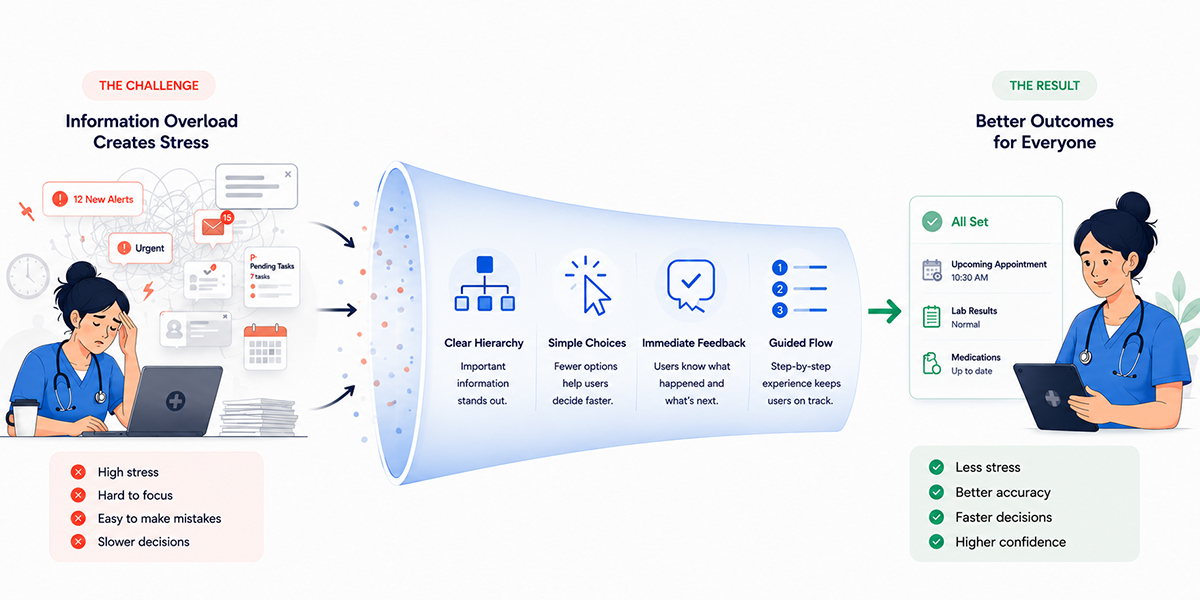
Rather than overwhelming users with options, effective interfaces organize information into a sequence that feels natural and predictable. The result is faster decisions, fewer mistakes, and a more confident user experience.
The Best Interface Is the One Nobody Notices
People rarely remember an application because of its animations or visual effects. They remember how easy it was to accomplish what they came to do.
That experience is created through hundreds of small design decisions working together. Clear visual hierarchy, consistent layouts, logical workflows, and predictable interactions reduce the amount of mental effort required throughout the journey.
When users no longer have to wonder where to click next or what happens after pressing a button, they can focus entirely on their actual task.
For healthcare professionals, that means spending more time caring for patients instead of navigating software. For patients, it means completing important actions with less anxiety and greater confidence.
Design for the Worst Five Seconds
Many products are tested under ideal conditions. Real life is rarely that forgiving.
Healthcare professionals are interrupted by phone calls, conversations, alarms, and changing priorities. Patients often use applications while feeling anxious or trying to understand unfamiliar medical information.
The most effective interfaces are designed with these moments in mind. Every screen should remain understandable even when users have only a few seconds to absorb the information in front of them.
Designing for distraction often leads to simpler navigation, clearer priorities, and fewer user errors. Ironically, products become more intuitive when designers assume users will never have their full attention.
Conclusion
Outstanding UX is not measured by how modern an interface looks. It is measured by how little effort users need to achieve their goal.
For organizations investing in healthcare application development, understanding the psychology behind user behavior is just as important as selecting the right technology stack. Interfaces that reduce cognitive load, simplify decision-making, and guide users naturally create experiences that are faster, more reliable, and easier to trust.
When good design removes unnecessary complexity instead of adding more features, people can focus on what truly matters. In healthcare, that can make every interaction more efficient for professionals and less stressful for patients.