There is a page most online shoppers know well. They arrive from an ad or a search result, scan a hero image, skim a few bullet points, and leave. Not because the product was wrong for them, and not because the price was unreasonable. They left because nothing on that page gave them a genuine reason to stay. It presented information without creating experience, and in a market shaped by creator content, social video, and contextual storytelling, that distinction has become decisive.
The static product page served its purpose for a different era of digital commerce. That era is over, and what is replacing it is more substantial than another design refresh.
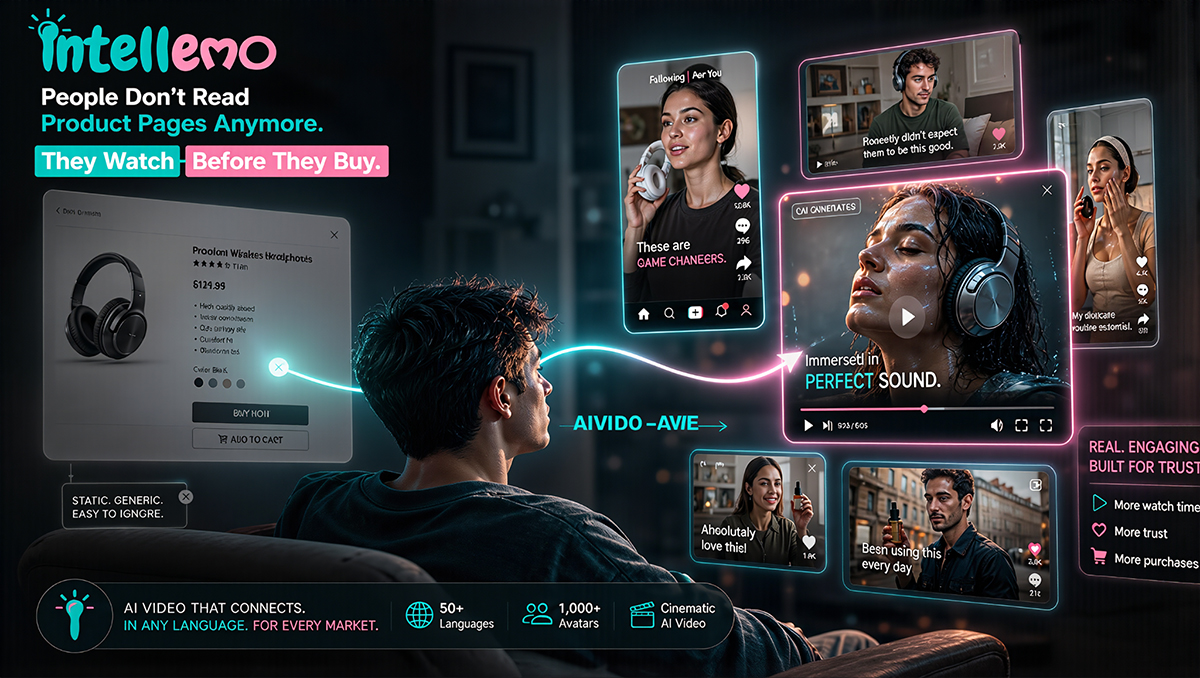
Why the Static Product Page Stopped Working
The original logic of the product page was straightforward: describe the product, show it, add a call to action, and let the customer decide. For the early internet, this was sufficient. Consumer behaviour, however, shifted in ways that made this model increasingly inadequate. People stopped forming purchase decisions on official product pages and started forming them through TikTok videos, Reddit threads, creator reviews, and unboxing content. The product page became a confirmation stop rather than a discovery tool.
A more fundamental problem followed: distrust. Polished studio photography and marketing-optimised feature copy began reading as suspicious to audiences who had been conditioned by authentic, contextual creator content. Shoppers learned to look past the official version of a product. They wanted to see it used by a real person, in a real setting, solving a real problem. A static page, by design, cannot do that. It presents the same fixed argument to every visitor regardless of who they are, what they care about, or what context they are browsing from.
What Buyers Actually Want Now
The need that static pages consistently fail to meet is not informational. It is imaginative. Consumers do not simply want to read about a product; they want to picture themselves using it. A skincare brand can list every active ingredient on its product page without ever answering the question a potential buyer is actually asking: does this work for someone who looks like me, in a climate like mine, with skin like mine? A description and a clean photograph cannot bridge that gap. Video can.
This is precisely why user-generated content became the dominant trust signal in digital commerce. Creator content worked not because creators were better marketers, but because their content was contextual, visual, and human in a way that official brand pages never managed to replicate. The challenge that followed for brands was a question of scale: how do you produce that kind of authentic, visually rich, contextual content at the volume and speed that modern marketing requires?
The brands arriving at a credible answer to that question are the ones treating video not as an element embedded inside a product page, but as the product experience itself.
The Three Technical Problems That Had to Be Solved
Early AI video generation tools recognised this opportunity but introduced new problems. Robotic voice delivery, characters that changed appearance between scenes, and lip-sync that was visibly misaligned with audio all produced outputs that damaged rather than built brand credibility. Three specific technical challenges had to be resolved before AI video could function as a genuine replacement for traditional production.
The first was character consistency. Without maintaining the same person across every scene and cut, there is no narrative coherence and no basis for viewer trust. The second was lip-sync accuracy. Human perception is extraordinarily sensitive to audio-visual mismatch, and even a fraction of a second of misalignment registers as deeply wrong. The third was cinematic quality, which extends well beyond resolution to include shot composition, motivated camera movement, lighting logic, and scene pacing. These are the details that determine whether a viewer watches a video or scrolls past it.
This reflects a broader shift among newer AI video platforms attempting to solve all three challenges simultaneously, particularly for brands that cannot afford content that appears robotic or low quality. The focus is increasingly on cinematic AI video generation that goes beyond simply converting text prompts into visuals, instead aiming to produce cinematically structured content with stronger character consistency, natural voice synchronisation, and coherent storytelling maintained across scenes. The broader objective is to make AI-generated video suitable for commercial storytelling and brand communication without requiring extensive manual correction or repeated regeneration cycles.
The Scale and Localisation Advantage
The limitations of static product pages become most visible when a brand attempts to operate across multiple markets. A company selling in ten countries needs ten versions of every piece of content, adapted for different languages, cultural contexts, and visual expectations. Traditional video production makes this prohibitively expensive. Most brands end up cutting corners, using subtitles instead of native voiceover, or reusing footage with translated text overlays. The result is content that does not feel made for the market it is targeting, which undermines the trust it is supposed to build.
AI product video generation changes this equation in a material way. A single video concept can now be adapted across dozens of languages with phonetically accurate lip synchronisation and culturally aligned visual representation from the same source content. Platforms such as Intellemo AI support multilingual video generation at scale, including support for more than 50 languages and large avatar libraries spanning diverse ethnicities, appearance types, and contextual settings. This makes it possible for a product advertisement intended for viewers in Brazil and one intended for viewers in Japan to look and sound genuinely different without requiring entirely separate production pipelines. The broader scale of these systems is reflected in their use across formats including product launches, brand documentaries, UGC-style content, and promotional campaigns
Long-Form Is Back, and AI Is the Reason
While short-form video dominated content strategy conversations for several years, long-form quietly became viable again. The reason it had retreated was straightforward: producing a structured brand documentary or multi-chapter educational video required film crews, multiple shoot days, professional editing, and production timelines measured in months. For content that might live on a product page, most brands could not justify that investment.
When AI video generation can produce a narratively coherent, visually consistent video of several minutes from a single prompt, the economics of long-form shift entirely. Maintaining story and visual consistency across a longer runtime is one of the genuinely difficult problems in AI video, and solving it is what distinguishes a complete platform from a clip-generation feature. For brands that have product stories worth telling in more depth than a 15-second hook allows, this capability opens formats that were previously closed to them.
What This Means for Brands and Marketers in Practice
The strategic reframe that matters most here is straightforward. The question is no longer whether a brand needs video content; consumer behaviour data has answered that conclusively. The question is whether the video content a brand produces is varied enough, localised enough, and produced at sufficient volume to do the job that static pages no longer can.
Building a library of contextual, format-varied video content, covering product hooks, explainers, UGC-style testimonials, and brand documentaries, used to mean choosing between quality and volume. The economics of traditional production did not allow for both simultaneously. AI video generation platforms built for cinematic output rather than merely fast output remove that constraint. Performance marketers who previously needed a dedicated production team to test twenty creative variations per week can now do so from a prompt and a platform, without sacrificing the visual quality that makes video worth watching in the first place.
The technology to build video-first product experiences is no longer restricted to brands with serious production budgets. That shift is already underway, and the brands acting on it now are building a content and learning advantage that compounds over time.
The Page Has Changed. The Standard Has Not.
The static product page is not being replaced by a better static product page. It is being replaced by video-first product experiences that can scale across languages and cultures, feel human rather than corporate, tell a story rather than list features, and adapt to the context of the person watching. That standard is not new. What is new is that the technology to meet it at scale, and at a cost that most brands can access, now exists.
Platforms like Intellemo AI make it possible to generate cinematic, character-consistent, multilingual product video content from a single prompt, without studio time, without a dedicated production team, and without the quality compromises that earlier AI tools imposed. The brands still relying on static pages are not simply behind on a design trend. They are working against a consumer psychology that has already moved on.
Frequently Asked Questions
1. Why do static product pages no longer convert as effectively?
Static pages present the same fixed content to every visitor with no adaptation for context, intent, or background. Modern buyers, shaped by creator content and video-first platforms, expect to see a product used in a real setting before committing to a purchase. A photograph and a feature list cannot meet that expectation.
2. Why does video outperform images and text for product marketing?
Video allows viewers to imagine themselves using a product in a way that static content cannot replicate. It communicates tone, texture, context, and personality simultaneously. Research consistently shows that product video increases time on page, reduces return rates, and improves conversion rates compared to image-only presentations.
3. What is AI product video generation and how does it work?
AI product video generation uses large language models, voice synthesis, and visual generation systems to produce structured video content from text prompts. Advanced platforms maintain character consistency across scenes, synchronise voice to lip movement accurately, and apply cinematic framing principles to produce output that reads as authored rather than generated.
4. How does multilingual video generation help brands operating across markets?
It allows a single video concept to be produced in multiple languages with phonetically accurate lip sync and culturally appropriate visual representation, from the same source content. This removes the need for separate production pipelines per market, making genuine localisation accessible at the speed and cost of a single-market campaign.
5. What should brands evaluate when choosing an AI video platform?
Character consistency across full-length videos, lip-sync accuracy, cinematic output quality, multilingual support, and whether the platform requires extensive post-generation editing. Platforms that produce complete, production-ready video from a single prompt represent a meaningfully different capability from tools that generate clips requiring manual assembly.