The 3D Shift Designers Didn’t See Coming—And Why It’s Quietly Transforming Contemporary Visual Culture
Some design revolutions arrive with hype, bold statements, and endless think-pieces. Others happen so gradually that we only notice them when they’re already reshaping the entire visual landscape.
Interactive 3D belongs to the second category.
It did not push its way into design workflows. Instead, it snuck into customers’ everyday expectations — people who simply wanted to comprehend a thing better than a snapshot could ever provide. Today, this modest transition has evolved into a complete overhaul of how digital products are presented, investigated, and evaluated.
Products Are No Longer Just Images—They Are Experiences
A single glance at any modern product page demonstrates how significantly visual behavior has evolved. Static photography has lost its monopoly, making way for interfaces that stimulate exploration. Users want to rotate an object, zoom in, check proportions, and look at details up close. They want authenticity and honesty, not stylized guessing.
This is why interactive technologies, such as a 3D product viewer, have become commonplace in many businesses without any public announcement. They address a fundamental need: the desire to immediately experience a product, even through a screen. This shift requires designers to treat visuals as functional components of the user journey, rather than decorative pieces placed on a layout.
Material Quality Has Become an Essential Part of Product Identity
In today’s design world, the realism of materials determines much of a product’s perceived value. Wood textures, cloth threads, metallic surfaces, and delicate highlights were previously captured via photography. They are now created digitally and demand the same amount of craftsmanship as traditional industrial design.
This is where 3D modeling and texturing services become increasingly vital. They ensure that materials behave credibly under various lighting conditions and stay consistent throughout all scenarios. As a result, surface quality has evolved into a new visual language, communicating emotion, workmanship, and brand identity long before fonts or layout are used.
CGI Did Not Replace Photography—It Replaced Waiting
Every designer knows how complicated it is to create high-quality visuals when half of the product samples are not yet available. Prototypes arrive late, production schedules shift, and photoshoots often require significant coordination.
CGI eliminated this reliance totally.
Products can now be visualized before they are manufactured.
Marketing campaigns may commence without delay.
Designers can create comprehensive layouts using fully formed objects rather than placeholders.
This is not a disruption for the sake of disruption; rather, it is a practical solution that has quietly streamlined the entire product-to-market process.
Motion Design Has Found a New Playground in Product Storytelling
Animation is no longer limited to logos or interface components. Brands are increasingly animating their products to illustrate functionality, explain technical decisions, and highlight distinctive features. These animations are intuitive and emotionally engaging, providing clarity that static graphics cannot.
For motion designers, this is a huge step. They are not just adding movement; they are choreographing bodily activity. Hinges, textures, reflections, and mechanical sequences all contribute to a visual story in which the viewer learns something meaningful about the object.
UI Design Is Gradually Becoming Three-Dimensional
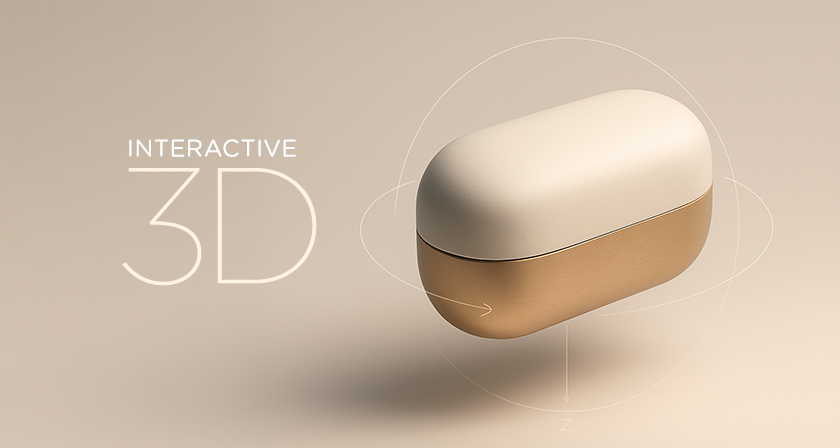
Although flat design is still extensively utilized, the visual world is gradually changing toward depth, dimension, and spatial interactivity. Hero parts frequently include floating product renders. Subtle motion effects show geometry when hovering. Interface layouts arrange elements as if they were in a curated digital exhibition rather than a flat grid.
This breakthrough alters the way designers think about composition. Instead of simply organizing things on a website, designers must examine how objects appear on the screen and how people connect with them visually and emotionally.
What Designers Now Need to Know About 3D
Designers are not required to grasp complicated 3D software. However, they must learn the principles of this new visual world. This includes understanding how physically-based materials react, how lighting impacts reality, how scale promotes trust, and how geometry alters the overall sense of a product.
This expertise is becoming a natural extension of design literacy, rather than a particular skill set for technical artists.
Practical Guidelines for Designers Using Interactive 3D
Several factors might help maintain clarity and visual quality when using 3D into product design:
Make lighting a key component of your visual identity. It frequently conveys mood more effectively than color palettes.
Maintain consistent texture quality. Inconsistent materials can make a strong design appear incomplete.
Use interactivity only when it significantly increases comprehension. Not every product benefits from a complete 360° exploration.
Allow sufficient room around the thing. To feel natural inside a layout, 3D elements must have enough breathing room.
Test on different monitors. The same highlight can appear modest on one screen but too brilliant on another.
These minor details add up to a polished experience.
The Future of Product Visualization Is Already Here
Interactive 3D did not take over visual culture through aggressive disruption. It was successful because it provided clarity, control, and authenticity, all of which consumers and designers value.
As organizations continue to embrace dimensional storytelling, designers who understand its logic will drive the next development of product identification. The shift has already occurred; the only question is how soon the design community will adapt to it.
The visual world is shifting toward depth, realism, and exploration, and this trend is here to stay.