As most of us working in digital design—or design in general—know well, starting a new job or project usually begins within a rectangle.
Whether it is something already framed or an idea with clearly defined dimensions—such as a screen, a poster, or a social media post—the format may vary, but the basic concept remains the same: there is a clearly defined space where the design lives, while everything outside of it becomes merely the background.
We designers often work in ways we rarely stop to question; we mechanically follow a routine or workflow that leads us to open our editing software—be it Illustrator, Photoshop, or even Figma for those creating web development mockups. In every case, the next step is identical: we create a project document with fixed dimensions and begin designing within them. From there, the usual decisions follow—typography, imagery, color, spacing, and composition—and we strive to make it all work within the boundaries of the canvas.
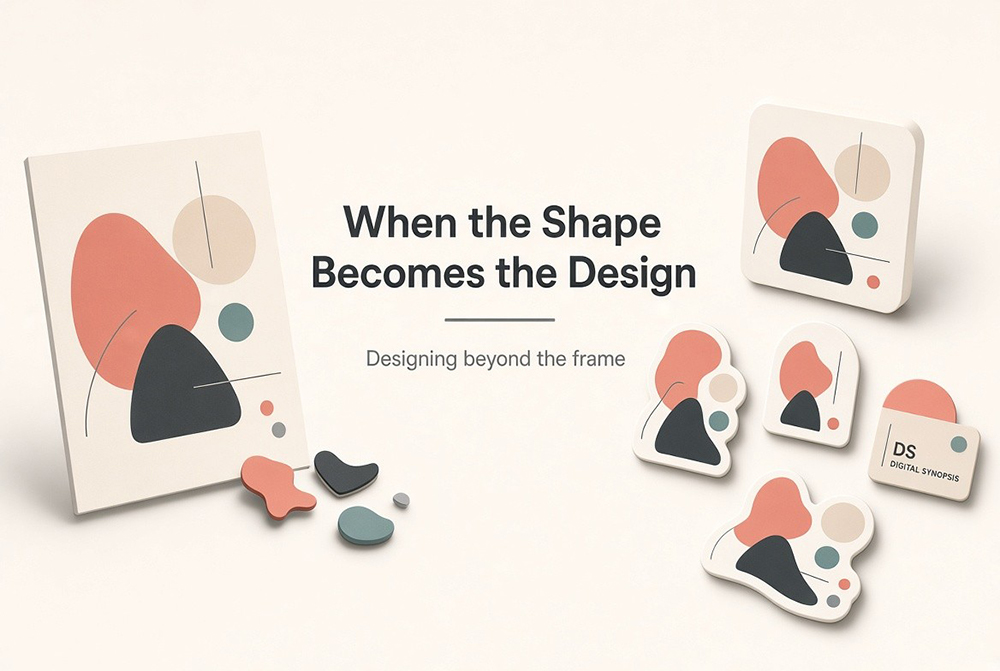
Things change a bit, however, when the design transitions to a physical object.
Here, the rules of the game shift. The medium—being integral to the concept and the object’s actual form—can follow the contours of an illustration. The object’s size shapes perception, the material adds texture, and the setting can change how people interact with it. Consider for a moment something as simple as packaging, a sticker, a sign, or perhaps a basic magnet; here, the design—or the result of our creativity—does not merely sit upon a surface. Instead, the surface, the form, and the surrounding space all play a part in the experience.
The question facing you as a designer is this:
“What should you place within this space?” or perhaps, “What shape should that space take?”
In physical objects, the form of the design is, to a large extent, just as important as the design itself.
Designing beyond the frame.
Visual identity works seamlessly within a digital grid, where the creator controls aspects such as positioning, proportions, and the relationships between elements. However, when that identity shifts to a physical medium, the constraints are not as rigid as they might seem; instead, new variables emerge that become integral to the design and the graphic solution itself.
For years, brands have understood the power of packaging; they have realized that even minute details—such as the silhouette of a container—can reinforce brand recognition and serve as an extension of the visual identity.
In signage, architecture and the surrounding space can determine the scale, orientation, and placement of graphic elements. A label, meanwhile, need not be limited to a rectangle: it can follow the product’s contours, letting its shape actively participate in the composition.
In all these instances, the medium ceases to be a neutral element.
The object’s surface, contours, and dimensions become part of the composition and can influence how the design is perceived.
This shifts the fundamental questions surrounding the creative process. Instead of asking solely which elements should appear within a given format, the designer can also consider what shape that format should take to reinforce the visual concept.
The result is a closer relationship between the design and the object itself. The physical form becomes part of the visual language.
Silhouette and Concept
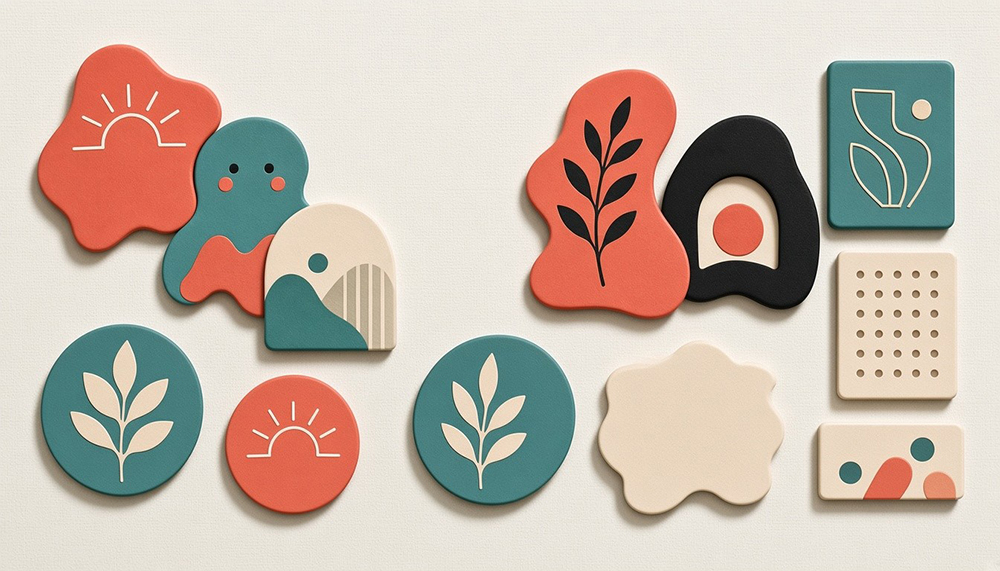
The simplest way to explore this idea is to work with custom objects, letting you define their shape, outline, or dimensions to match your design concept. A design doesn’t have to be rigidly confined to squares, rectangles, or other predefined formats. An illustration, a symbol, or even a logo can follow its own unique silhouette.
Custom fridge magnets are a simple example of this principle. Instead of placing an illustration inside a standard rectangle, the object’s outline can mirror the shape of the illustration itself.
A character can retain its original form; a symbol can become a physical object; and an illustration can keep its specific outline.
The difference may seem minor, but it alters the relationship between the design and the medium. The shape ceases to be merely a container for the image and begins to become part of the image itself.
When Design Occupies Space
A physical object shares space with its surroundings, and this affects how it is perceived. The relationship between space and object is crucial here; packaging is destined for the customer’s hands, a poster ends up on a wall, and a graphic piece likely sits on a desk. All these objects create harmony or impact the perception of their environment. Their scale, position, and setting become part of the experience.
This principle also applies to materials: smooth or textured surfaces, matte or glossy finishes, the object’s edges, its shadow, or even the way light falls upon it can alter the design’s appearance. The underlying idea is that objects affect the physical environment where they end up; therefore, considering their physical qualities ensures the object itself doesn’t compromise the design’s final perception.
Scale is another important factor, opening up a wide range of possibilities depending on the intended effect or experience. A small-scale object might be designed to be discovered only upon close inspection, whereas a larger object might aim to command attention within a space. An illustration featuring organic shapes, for instance, can gain impact when its outline aligns with the contours of the object displaying it.
For designers, these physical qualities create a different kind of canvas—one shaped not only by what is printed on it, but also by its form, surface, scale, and surroundings. These qualities can give a visual identity a stronger physical presence, especially when the form, scale, and surroundings reinforce the idea behind the design. The design has dimensions, occupies space, can be touched, and coexists with other objects. It may even remain in that space long after the person has stopped interacting with it.
This is precisely what makes bringing a visual identity into the physical world so compelling. The object does more than just display the design; it shapes the way that design is experienced.
Beyond the Screen
Graphic design does not necessarily end when a file is exported.
Sometimes, a visual identity takes on a new dimension when it leaves the screen and begins to occupy real space. Its shape, size, surface, and placement all become part of the experience.
For a designer, this means having a different kind of canvas to work with. An object can carry an identity, but it can also give it a new form.
And perhaps that is the most interesting part: when design is no longer limited to what we see on a screen and begins to become part of the world around us.