AI is reshaping how technical teams plan software and UX design projects and collaborate on them. Nothing highlights this shift more clearly than the surge in demand for text-based diagramming formats, most notably Mermaid.
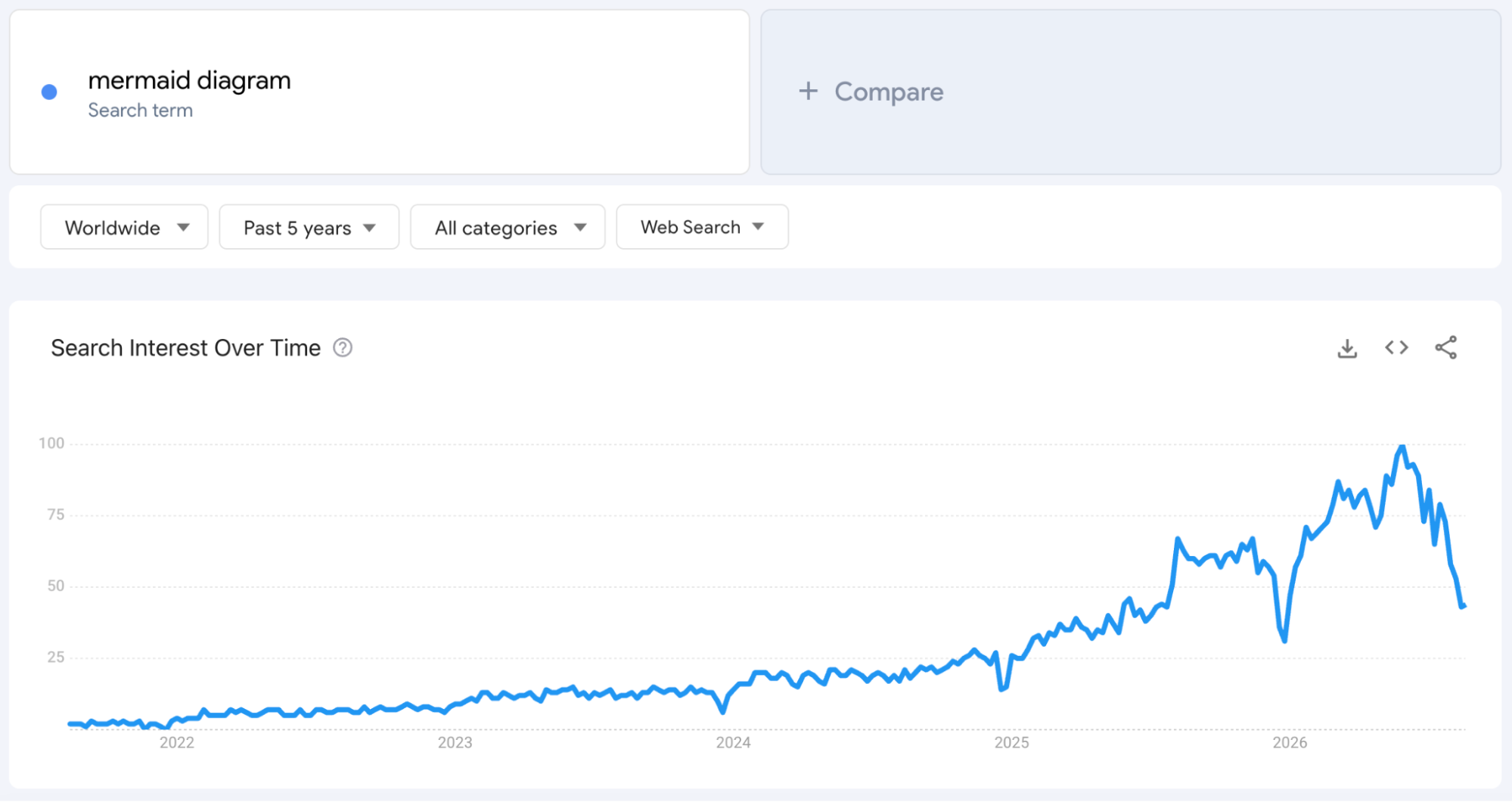
According to a recent analysis of Google Trends and analytics data conducted by researchers at intelligent canvas platform Miro, worldwide searches for “Mermaid diagram” hit record levels earlier this year, driven directly by major AI platforms embedding it into their platform offering.
What was once a niche markup tool is now becoming the translation layer between AI code generation and human comprehension.
The Rise of Text-Based Visuals in the AI Era
The search interest for Mermaid diagrams has grown steadily since 2022, but the momentum accelerated in the last year. Interest peaked at a score of 100 in early June, with over 200,000 queries in a single month, according to data from Glimpse. Related searches jumped even higher, up 330% year-over-year by mid-summer.
This surge correlates with widespread adoption across developer environments. In May, GitHub introduced built-in Mermaid diagram rendering to Copilot’s Markdown preview in VS Code. By July, leading AI platforms including OpenAI’s Codex and Anthropic’s Claude Code rolled out native Mermaid support, followed quickly by popular knowledge management platforms like Bear.
When Miro launched its own native Mermaid integration in August, weekly active user growth soared by 96%. Unsurprisingly, the main adopters driving this curve by job role were in Engineering, Product, and Operations roles.
Shifting Workflows: From Review Documentation to Upfront Alignment
Traditionally, teams mapped visuals such as architecture diagrams, user journey flows, and process charts in one of two ways. They either spent hours manually crafting static diagrams before writing code, or wrote detailed documentation after finishing a project.
As AI coding agents take on more software development tasks, the process keeps evolving. AI increases the pace, so developers and UX designers increasingly need real-time visual feedback to audit and validate what automated systems generate. Text-based diagramming helps close that gap because AI models excel at generating Markdown and code-based text formats.
Instead of writing dense code or reading thousands of lines of output, engineers can prompt an AI assistant to output a system flow as a Mermaid script and immediately create a visual architecture diagram. UX designers can similarly instruct AI to render interactive user journeys or state machine diagrams from brief feature descriptions.
Human-in-the-Loop Collaboration
This evolution shifts the purpose of visual collaboration tools.
Diagrams no longer sit at the end of a process as static blueprints or archival deliverables. They now work as live starting points for teams to get on the same page.
Miro Product Manager Hannah Knight points out that AI is moving visual collaboration to the start of the development lifecycle instead of leaving it as an end result:
“As AI coding agents become more capable, developers have needed a way to see and validate what those systems are building, and Mermaid has emerged as a natural format for that. AI is moving diagrams from something people create manually at the end of a process to something that can be generated throughout or at the beginning as a way of understanding and shaping AI’s work.”
In practice, this means human expertise is repositioned in more key areas that are defined as momentum work: decision-making, contextual refinement, and driving innovative methods.
Rather than starting with a blank canvas, product managers, developers, and UX designers can begin with an AI-generated visual baseline. This helps refine the structure collaboratively, and sets clear guidelines before generating any code.
The New Bridge for Human-AI Interaction
This widespread adoption of Mermaid points to a lasting change in how technical teams work with AI.
As AI systems generate a growing share of modern software, teams need transparent diagramming tools to decode complex logic quickly. Text-based formats like Mermaid give them a bridge between AI-generated systems and human intuition.