Agency pitches have a habit of approving a character before anyone has heard her. The art director settles the face, the wardrobe and the pose, and the client signs off on a still. The voice is often chosen weeks later in a casting session, sometimes by people who never saw the early sketches.
Say the brief calls for a night-shift ferry captain, an invented woman in her fifties whom commuters would trust to get them home through fog. The art director has generated a front-facing portrait of her, sharply lit, with a knit cap and a weathered face. The copywriter has read the script twice herself: once low and steady, once bright and quick. On paper both reads work, and the team splits down the middle.
That disagreement gets shorter once the team makes a talking photo of the portrait for each read and plays the two clips side by side. Each clip is built to have the captain’s portrait speak one of the copywriter’s takes, so the room hears every voice against that face before anyone defends a favourite.
A Character Sheet Has No Sound
A finished character sheet is a quiet document. It fixes the silhouette, the palette, the clothes and sometimes a row of expressions. The voice, if it appears at all, is a line of adjectives near the bottom: “warm”, “confident”, “a bit dry”.
Those adjectives do a lot of work later. The casting director reads them, actors interpret them, and a voice gets picked that matches the words. Whether it matches the face is a separate question, and it often gets asked only when the first edit comes back.
By then the look is approved and costly to change. If the voice and the picture pull in different directions, the usual fix is a different read. That can mean another session and a new round of client notes. Teams that have been through this tend to bring the voice into the conversation earlier, even in rough form.

York Researchers Paired Strangers’ Faces With Recorded Voices
There is published research on how much a voice changes what people read into a face. Across five experiments, a University of York study in the Journal of Experimental Psychology: Human Perception and Performance looked at how faces and voices shape two first impressions, dominance and trustworthiness. In three of them, participants rated a face and a voice presented together.
The faces were photos of 20 unfamiliar people found through an internet search. The voices came from 20 speakers recorded saying the same sentence: “I wouldn’t do that if I were you.” Each recording was digitally shifted to a higher and a lower pitch. In a first test, listeners rated the lower versions as more dominant. Participants rated each pairing on a scale from 1 to 9.
In the dominance study, with 64 participants, the average rating rose from 4.0, when a low-dominance face met a low-dominance voice, to 5.8 when both were high. A low-dominance face with a dominant voice was rated 5.1. A dominant face with a low-dominance voice got 4.6. The authors write that “voices have the larger influence in judgments of dominance”, while “faces have the larger influence in judgments of trustworthiness.”
The trust study, with 40 participants, showed the same split from the other side. Mean ratings ran from 4.8 to 6.2, and the face made the bigger difference.
A third experiment, with 80 participants from the University of York, told people to judge only the face or only the voice. That instruction did not fully work. The researchers found that “the channel that participants were instructed to ignore nevertheless had a significant, though smaller, effect on dominance ratings.”
The study has a clear limit, and the authors name it. The voices “were paired with static faces”, a method they say “unquestionably misrepresents real-life social interactions.” Nobody in it looked at an ad or a campaign character. They rated strangers.
The Voice Weighed More For Dominance, The Face For Trust
For a character brief, that pattern suggests a division of labour. If it carries over from photos of strangers to an invented campaign character, which the study did not test, then authority is largely a casting decision. A captain briefed as calm and in command could lose that command to a light, high read, however steady her portrait looks.
Trust may run the other way. In the York data the face did more of that work, so a captain whose portrait reads as guarded could be hard for any voice to warm up. That part of the brief sits with the art director rather than the casting session.
The third experiment adds a quieter point. People could not switch one channel off when asked to. A team that judges the portrait alone, in silence, is judging a version of her that a viewer of the finished spot will never meet.
Write The Voice Into The Character Brief
None of this needs special equipment. It needs the voice written down with the same care as the wardrobe, early enough for the client to approve both together. A few lines usually cover it:
- Pace: how fast she talks when nothing is going wrong.
- Pitch range: where her voice sits, and how far it moves under pressure.
- Warmth: whether she sounds like she is reassuring passengers or giving orders to crew.
- The test line: one sentence from the script that has to carry the whole character.
The test line matters most. It should be a sentence where the wrong voice would be obvious, and that is rarely the tagline. For the captain, it might be the moment she tells passengers the crossing will run late.
Delivery deserves a note too. Phil McAleer is a psychologist quoted in a University of Glasgow news release on his team’s voice research. He put it plainly: “The more monotone or flat the voice sounded, the less appealing it was to the listener.” He added that “a voice with a bit more personality and intonation gave the best and most positive impression.” A brief that says “steady” should probably say whether steady also means flat.
Hearing The Pairing Before The Casting Brief
Back in the pitch room, the two talking clips of the captain are scratch material. They help the team decide which kind of read to ask for. The casting brief can then say “low, unhurried, a little warmer at the end of each sentence” rather than three loose adjectives. A professional actor is still cast, and the copywriter’s takes stay in the pitch folder.
The clips also sit a step closer to how a viewer meets a character than a recording played next to a still. A clip of this kind is still a rough check, though, not a test of the finished spot.
The fairest comparison uses a face-on or three-quarter portrait with nothing covering the face. The take should be dry, with no music or room echo. Every clip is watched before it reaches a deck, and a rerun on a different take is routine.
The pitch notes record where each piece came from. The captain is invented, generated from a description, so her portrait shows no real person. Each take was recorded by a team member for this comparison, and that person agreed to it. A photo of a real person, even someone on the team, is never used as the source.
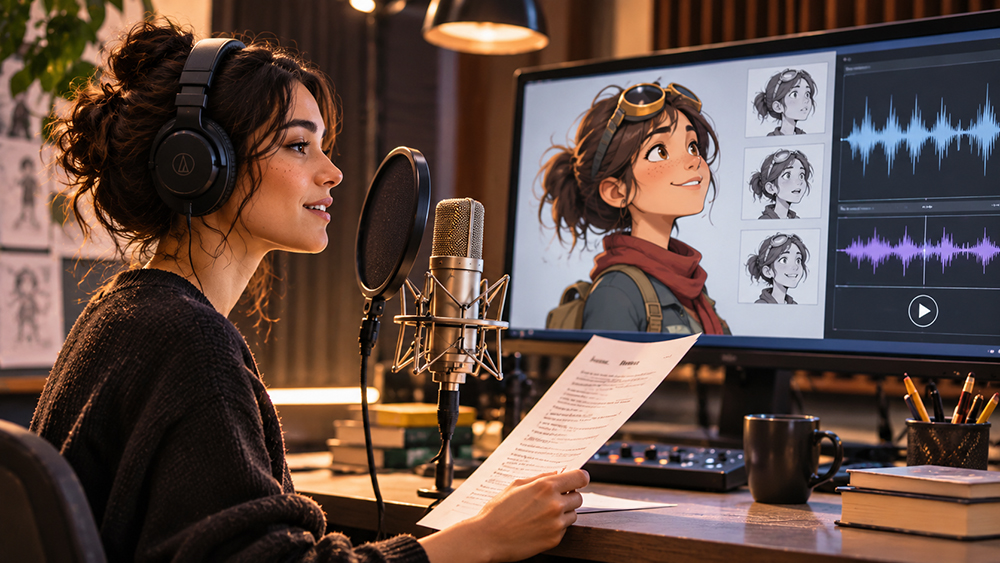
A Character Is Remembered Speaking
A client approves a campaign character as an image, usually on a single slide. Audiences meet her moving and talking, on a pre-roll or a screen in a ferry terminal, a few seconds at a time. The York results, gathered on photos of strangers, suggest that first impressions mix what people see with what they hear, even when they are told to ignore one of the two.
That puts the microphone inside the design process. The captain’s knit cap and weathered face took weeks of revisions. Her voice deserves a few rounds of the same attention before the client hears it for the first time.